
Supported by the Simons Foundation
Shape of Life
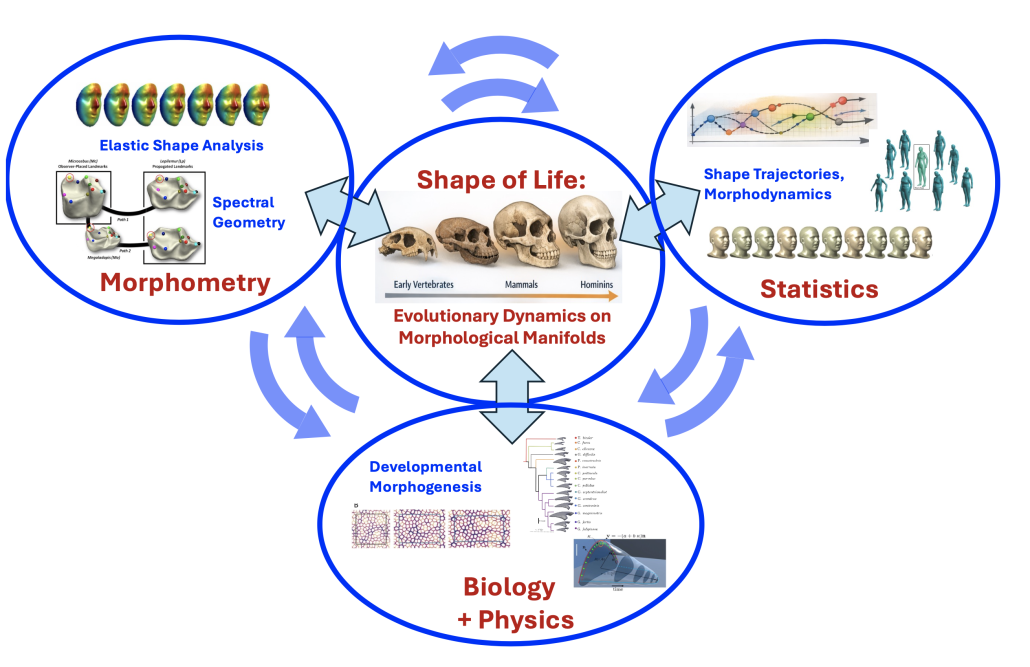
Quantifying the Geometry of Living Form
Life leaves traces in bone, shell, scale,
tooth, antler, wing, skull, leaf, and limb.
These forms are not merely catalogues of biological diversity. They are
records of growth, development, function, constraint, and evolutionary
possibility. Shape of Life is an interdisciplinary project to build a
quantitative science of biological form — linking geometry, physics,
computation, statistics, paleontology, and biology to understand how
living shapes arise, diversify, persist, and transform.
The Shape of Life aims to build a new quantitative science of biological form by combining the world’s fossil collections with modern biology, mathematics, physics, statistics, and computation. Building on catalogues of extinct diversity in museums and our understanding of developmental processes in extant organisms, the project will ask how living forms—e.g. skulls, bones, wings and leaves—change and diversify through evolution. Using a curated “atlas of shape,” the team will develop mathematical and computational models of developmental dynamics and plausible evolutionary transformations, with the ultimate goal of uncovering the physical and biological principles that govern the evolution of functional shape across deep time.
The Central Question
How can we compare forms across life and deep time in a way that
captures not only their appearance, but their generative potential?
The goal is to move beyond descriptive morphology toward a mathematical
and physical account of form: a framework in which biological shapes can
be represented, compared, modeled, and simulated.
Vision
A morphodynamic atlas of life
We aim to reconstruct a quantitative map of how form changes across
development, ecology, and evolution. Within this atlas, shapes are treated
as points, paths, and distributions on high-dimensional geometric spaces.
Evolution becomes a flow through these spaces — constrained by physics,
shaped by development, and filtered by function and environment.
The project asks whether the diversity of living form can be understood
through a small number of interacting principles: geometry, growth,
physics, variation, constraint, and selection.
Why Now
A new synthesis is possible
Museum collections and digital scans provide unprecedented access to
fossil and extant forms. Discrete differential geometry allows complex
biological structures to be represented as analyzable meshes. Statistical
shape analysis and functional data methods make it possible to compare
forms across clades, environments, and developmental stages.
Physics links morphology to growth, elasticity, flow, fracture, and active
matter, while modern computation turns these ideas into generative and
testable models. Together, these tools make it possible to transform the
qualitative tree of life into a quantitative landscape of shape.
Scientific Goals
Represent and compare form
Develop robust geometric descriptions of biological shapes that preserve
curvature, topology, symmetry, scale, and connectivity — and statistical
and computational methods for comparing shapes across species, fossil
lineages, developmental stages, and ecological contexts.
Model form
Use physical and geometric principles to infer the rules by which forms
grow, deform, branch, fuse, fold, and fracture, and build generative
models capable of producing plausible morphologies consistent with
biological, developmental, and physical constraints.
Infer evolvability
Quantify how the capacity to generate new forms changes across
evolutionary history, ecological opportunity, and developmental
architecture.
Research Themes
Geometry of shape
Biological form treated through differential geometry, discrete geometry,
shape spaces, curvature flows, and diffeomorphic matching.
Physics of morphogenesis
Growth, rheology, active stresses, and material constraints modeled as
drivers of form.
Statistical morphology
Shape variation analyzed using statistical inference, functional data
analysis, information geometry, and probabilistic models.
Evolutionary dynamics
Fossil and extant morphologies interpreted as samples from evolving
distributions of form, constrained by phylogeny, development, and
environment.
Computation and simulation
Geometry-aware algorithms, differentiable solvers, and machine learning
tools connecting raw scans to models, inference, and prediction.
The Collaboratory
Form as both data and dynamics
Shape of Life is designed as a collaboratory linking mathematicians,
physicists, computer scientists, statisticians, biologists,
paleontologists, and museum collections. No single field can solve the
problem of form. Geometry provides representation. Physics provides
mechanism. Statistics provides inference. Computation provides scale.
Biology and paleontology provide meaning, constraint, and reality.
People
Group members
Group Director
-

Harvard University
Principal Investigators
-

Carnegie Mellon University
-

Syracuse University
-

Florida State University
Collaborating Scientists
-

Duke University
Group Scientists
Postdocs, graduate students, and consultants — to be announced.