

We use experiments, theory and computation to study motion and matter at the human scale. Areas of interest include the patterns of shape and flow of inanimate matter in systems ranging from the supramolecular to the planetary, and the dynamics of sentient matter that can self-organize, perceive and act in systems ranging from the sub-cellular to the super-organismal. Via answers to specific questions, we aim to get at general principles, if there be such, and get a qualitative understanding using quantitative methods – Soft Math !

Slithering Snakes: The Science Behind the Motion of a Young Anaconda

Robots made of linked particle chains

How do bird nests stay together?

I ❤️️ kirigami.

Can you change a chicken into a frog, a fish or a chameleon?

Reverse engineering Jackson Pollock.

You hear the musical saw. These mathematicians heard geometry.

Fired from brushing his daughter’s hair, a scientist uses math to detangle the problem
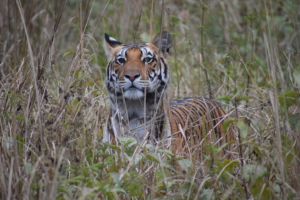
Turing's Tyger. L Mahadevan. Visualizing Climate and Loss, 23 Mar 2026.
[PDF]
In "Turing's Tyger," mathematician L. Mahadevan reflects on the collapse of wild tiger populations (from ~100,000 in 1900 to ~3,000 by 2000, rebounding modestly to ~6,000 today, versus ~9,000 in unregulated captivity) and his personal quest to understand the origins of tiger stripe patterns. Drawing on a visit to the Natural History Museum in London - where he photographed preserved tiger skins for statistical analysis of stripe patterns — and a first-ever wild tiger sighting at Kanha National Park in January 2026, he connects this fascination to Alan Turing's 1952 theory of morphogenesis (reaction-diffusion patterns), asking whether such models could explain how stripes form and vary across individuals, generations, and evolutionary time. The essay closes on a conservation note, framing the scientific inquiry as a path toward deeper understanding and protection of the species.
In "Turing's Tyger," mathematician L. Mahadevan reflects on the collapse of wild tiger populations (from ~100,000 in 1900 to ~3,000 by 2000, rebounding modestly to ~6,000 today, versus ~9,000 in unregulated captivity) and his personal quest to understand the origins of tiger stripe patterns. Drawing on a visit to the Natural History Museum in London - where he photographed preserved tiger skins for statistical analysis of stripe patterns — and a first-ever wild tiger sighting at Kanha National Park in January 2026, he connects this fascination to Alan Turing's 1952 theory of morphogenesis (reaction-diffusion patterns), asking whether such models could explain how stripes form and vary across individuals, generations, and evolutionary time. The essay closes on a conservation note, framing the scientific inquiry as a path toward deeper understanding and protection of the species.
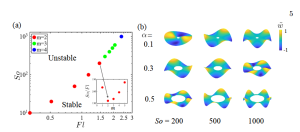
Elastohydrodynamic instability of a spinning elastic disk. S Yin, P Kaneelil, L Mahadevan. arXiv, 21 Jul 2026.
[PDF]
A soft thin elastic disk spinning in a viscous fluid experiences centrifugal tension generated by rotation together with viscous shear generated by the surrounding flow. While the former stabilizes the flat state, the latter can destabilize it. We combine the linearized F\"{o}ppl-von K\'{a}rm\'{a}n equations for a rotating elastic disk with the shear stresses arising from the classical von K\'{a}rm\'{a}n swirling flow to derive an elastohydrodynamic stability problem. Linear stability analysis identifies the onset of buckling in terms of two dimensionless control parameters measuring centrifugal stiffening and fluid-induced shear. Above threshold the disk buckles into azimuthally periodic saddle-like modes whose wavenumber increases with increasing rotational tension. The buckled configuration also supports retrograde traveling waves that rotate more slowly than the material frame. These results identify a simple mechanism whereby fluid shear destabilizes rotating elastic structures.
A soft thin elastic disk spinning in a viscous fluid experiences centrifugal tension generated by rotation together with viscous shear generated by the surrounding flow. While the former stabilizes the flat state, the latter can destabilize it. We combine the linearized F\"{o}ppl-von K\'{a}rm\'{a}n equations for a rotating elastic disk with the shear stresses arising from the classical von K\'{a}rm\'{a}n swirling flow to derive an elastohydrodynamic stability problem. Linear stability analysis identifies the onset of buckling in terms of two dimensionless control parameters measuring centrifugal stiffening and fluid-induced shear. Above threshold the disk buckles into azimuthally periodic saddle-like modes whose wavenumber increases with increasing rotational tension. The buckled configuration also supports retrograde traveling waves that rotate more slowly than the material frame. These results identify a simple mechanism whereby fluid shear destabilizes rotating elastic structures.
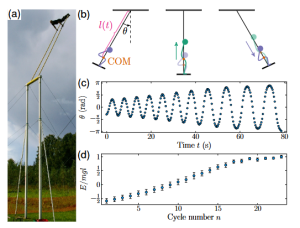
Optimal strategies for kiiking: active pumping to invert a swing. P Bryde, I Davenport, L Mahadevan. Journal of Nonlinear Science, 15 Jul 2026.
[PDF]
Kiiking is an extreme sport in which athletes alternate between standing and squatting to pump a swing with rigid supporting arms until it completes a full rotation. A minimal model of the task may be cast in terms of an active pendulum driven by varying its length, and raises the question of optimal strategies for this problem at the nexus of physics and control. We show that a time-optimal control perspective, subject to known biomechanical constraints which aims to maximize the potential energy gain at the end of each cycle explains observations of athletic performance. When accounting for air drag, our theoretical framework is quantitatively consistent with experimental observations and elucidates the importance of strength and timing while pointing to the ultimate limits of kiiking.
Kiiking is an extreme sport in which athletes alternate between standing and squatting to pump a swing with rigid supporting arms until it completes a full rotation. A minimal model of the task may be cast in terms of an active pendulum driven by varying its length, and raises the question of optimal strategies for this problem at the nexus of physics and control. We show that a time-optimal control perspective, subject to known biomechanical constraints which aims to maximize the potential energy gain at the end of each cycle explains observations of athletic performance. When accounting for air drag, our theoretical framework is quantitatively consistent with experimental observations and elucidates the importance of strength and timing while pointing to the ultimate limits of kiiking.
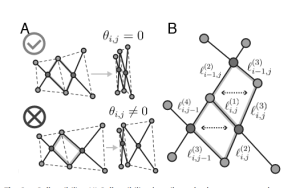
Collapsible scissored surfaces. N Toyonaga, S Nishimoto, C Decker, T Tachi, R Wood, L Mahadevan. Proceedings of the National Academy of Sciences, USA, 18 Jun 2026.
[PDF]
We introduce an additive approach for the design of a class of transformable structures based on two-bar linkages (“scissor mechanisms”) joined at vertices to form a two-dimensional mesh which we call a pantograph lattice. Our approach shows how these lattices unfold from a one-dimensional collapsed state to two-dimensional surfaces of single and double curvature. We provide an algorithm for growing pantograph structures that allows us to explore the full space of possible mechanisms, and we use it to computationally design and physically assemble a series of examples of varying complexity. We finally demonstrate a streamlined method for automated fabrication of pantograph lattices using multimaterial 3D printing.
We introduce an additive approach for the design of a class of transformable structures based on two-bar linkages (“scissor mechanisms”) joined at vertices to form a two-dimensional mesh which we call a pantograph lattice. Our approach shows how these lattices unfold from a one-dimensional collapsed state to two-dimensional surfaces of single and double curvature. We provide an algorithm for growing pantograph structures that allows us to explore the full space of possible mechanisms, and we use it to computationally design and physically assemble a series of examples of varying complexity. We finally demonstrate a streamlined method for automated fabrication of pantograph lattices using multimaterial 3D printing.
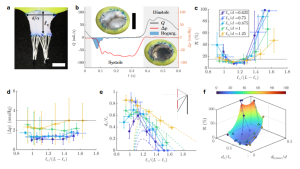
Parametric engineering of atrioventricular living valve transplants. PR Kaneelil, KJ Hon, DP Recco, N Thatte, G Dafflisio, PE Hammer, L Mahadevan, S Emani. arXiv, 18 Jun 2026.
[PDF]
Diseases of the (mitral and tricuspid) atrioventricular valves (AVV), which regulate inflow from the atria to the ventricles, can result in severe obstruction to inflow (stenosis) or valvular leakage (regurgitation), requiring surgical intervention. In patients with small annulus diameters (< 19 mm), valve replacement is a clinical challenge limited by prosthesis size constraints, lack of growth potential, suboptimal durability, and elevated thrombosis and bleeding risk. While living valve transplantation (LVT) has re-opened the possibility of using allogeneic valve tissue capable of growth and remodeling, translating this to the AVV has been challenging given the anatomical complexity of the sub-valvular apparatus. Here, we propose a strategy using a replacement bi-leaflet cylindrical valve fabricated from donor AVV tissue and artificial chordae, with a geometry designed to mimic the native AVV and engineered to satisfy predefined clinical targets. Pulse duplicator experiments allowed characterization of valve dynamics in terms of clinically important attributes framed as dimensionless parameters. A multi-objective optimization allowed us to identify an optimal design which we implemented in porcine AVV replacements (n=6). Our results demonstrated favorable hemodynamics with minimal regurgitation and stenosis, suggesting a promising method for patient-optimized valve replacements.
Diseases of the (mitral and tricuspid) atrioventricular valves (AVV), which regulate inflow from the atria to the ventricles, can result in severe obstruction to inflow (stenosis) or valvular leakage (regurgitation), requiring surgical intervention. In patients with small annulus diameters (< 19 mm), valve replacement is a clinical challenge limited by prosthesis size constraints, lack of growth potential, suboptimal durability, and elevated thrombosis and bleeding risk. While living valve transplantation (LVT) has re-opened the possibility of using allogeneic valve tissue capable of growth and remodeling, translating this to the AVV has been challenging given the anatomical complexity of the sub-valvular apparatus. Here, we propose a strategy using a replacement bi-leaflet cylindrical valve fabricated from donor AVV tissue and artificial chordae, with a geometry designed to mimic the native AVV and engineered to satisfy predefined clinical targets. Pulse duplicator experiments allowed characterization of valve dynamics in terms of clinically important attributes framed as dimensionless parameters. A multi-objective optimization allowed us to identify an optimal design which we implemented in porcine AVV replacements (n=6). Our results demonstrated favorable hemodynamics with minimal regurgitation and stenosis, suggesting a promising method for patient-optimized valve replacements.
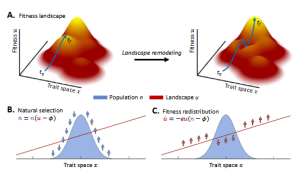
Self-propelled evolution on regenerating landscapes. A Heyde, L Mahadevan. arXiv, 14 Jun 2026.
[PDF]
Evolving populations both respond to and reshape their environments, making fitness landscapes dynamic rather than static. We present a minimal eco-evolutionary model that couples replicator dynamics for a population density with a regenerating resource-driven landscape through a single environmental sensitivity parameter. This allows evolving populations to generate and ride self-induced selection gradients, enabling directed motion in trait space even on initially flat landscapes. Our analysis reveals sustained oscillations, chaotic dynamics, and evolutionary branching. To explain these, we derive reduced dynamical equation that extend Fisher's fundamental theorem to deformable landscapes by incorporating curvature-driven variance dynamics and environmental feedback. Together, these results show how populations actively reshape and self-propel themselves on regenerating landscapes.
Evolving populations both respond to and reshape their environments, making fitness landscapes dynamic rather than static. We present a minimal eco-evolutionary model that couples replicator dynamics for a population density with a regenerating resource-driven landscape through a single environmental sensitivity parameter. This allows evolving populations to generate and ride self-induced selection gradients, enabling directed motion in trait space even on initially flat landscapes. Our analysis reveals sustained oscillations, chaotic dynamics, and evolutionary branching. To explain these, we derive reduced dynamical equation that extend Fisher's fundamental theorem to deformable landscapes by incorporating curvature-driven variance dynamics and environmental feedback. Together, these results show how populations actively reshape and self-propel themselves on regenerating landscapes.

 Prof. L. Mahadevan
The sublime in the mundane
Like the scientist, the minds of children are eternally and sometimes infernally curious about everything – the familiar is after all, still not yet so ! Alas, with time we all fall into the same trap, numbed by the mundane, searching for the sublime.
Watching Paint Dry by L. Mahadevan, The Harvard Undergraduate Research Journal
Somewhat reversing the trend towards reductionism, over the last few decades there has been a growing appreciation of the richness and variety of phenomena that arise from relatively few and fairly simple causes in the natural world.