Animal cell hydraulics
[View PDF] [Download PDF]
Abstract
Water is the dominant ingredient of cells and its dynamics are
crucial to life. We and others have suggested a physical picture
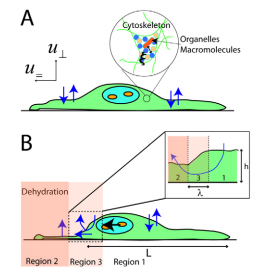
of the cell as a soft, fluid-infiltrated sponge, surrounded by a
water-permeable barrier. To understand water movements in
an animal cell, we imposed an external, inhomogeneous osmotic
stress on cultured cancer cells. This forced water through the
membrane on one side, and out on the other. Inside the cell, it
created a gradient in hydration, that we visualized by tracking
cellular responses using natural organelles and artificially
introduced quantum dots. The dynamics of these markers at
short times were the same for normal and metabolically
poisoned cells, indicating that the cellular responses are
primarily physical rather than chemical. Our finding of an
internal gradient in hydration is inconsistent with a continuum
model for cytoplasm, but consistent with the sponge model, and
implies that the effective pore size of the sponge is small enough
to retard water flow significantly on time scales (~10–100
seconds) relevant to cell physiology. We interpret these data in
terms of a theoretical framework that combines mechanics and
hydraulics in a multiphase poroelastic description of the
cytoplasm and explains the experimentally observed dynamics
quantitatively in terms of a few coarse-grained parameters that
are based on microscopically measurable structural, hydraulic
and mechanical properties. Our fluid-filled sponge model could
provide a unified framework to understand a number of
disparate observations in cell morphology and motility.


Prof. L. Mahadevan