Dissolution-driven convection in a Hele-Shaw cell
[View PDF] [Download PDF]
Abstract
Motivated by convection in the context of geological carbon-dioxide (CO2) storage,
we present an experimental study of dissolution-driven convection in a Hele–Shaw
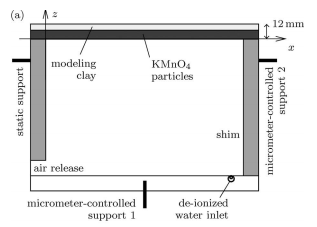
cell for Rayleigh numbers R in the range 100 < R < 1700. We use potassium permanganate (KMnO4) in water as an analog for CO2 in brine and infer concentration
profiles at high spatial and temporal resolution and accuracy from transmitted light
intensity. We describe behavior from first contact up to 65% average saturation and
measure several global quantities including dissolution flux, average concentration,
amplitude of perturbations away from pure one-dimensional diffusion, and horizontally averaged concentration profiles. We show that the flow evolves successively
through distinct regimes starting with a simple one-dimensional diffusional profile.
This is followed by linear growth in which fingers are initiated and grow quasiexponentially, independently of one-another. Once the fingers are well-established,
a flux-growth regime begins as fresh fluid is brought to the interface and contaminated fluid removed, with the flux growing to a local maximum. During this regime,
fingers still propagate independently. However, beyond the flux maximum, fingers
begin to interact and zip together from the root down in a merging regime. Several
generations of merging occur before only persistent primary fingers remain. Beyond
this, the reinitiation regime begins with new fingers created between primary existing ones before merging into them. Through appropriate scaling, we show that the
regimes are universal and independent of layer thickness (equivalently R) until the
fingers hit the bottom. At this time, progression through these regimes is interrupted
and the flow transitions to a saturating regime. In this final regime, the flux gradually decays in a manner well described by a Howard-style phenomenological model.


Prof. L. Mahadevan

